
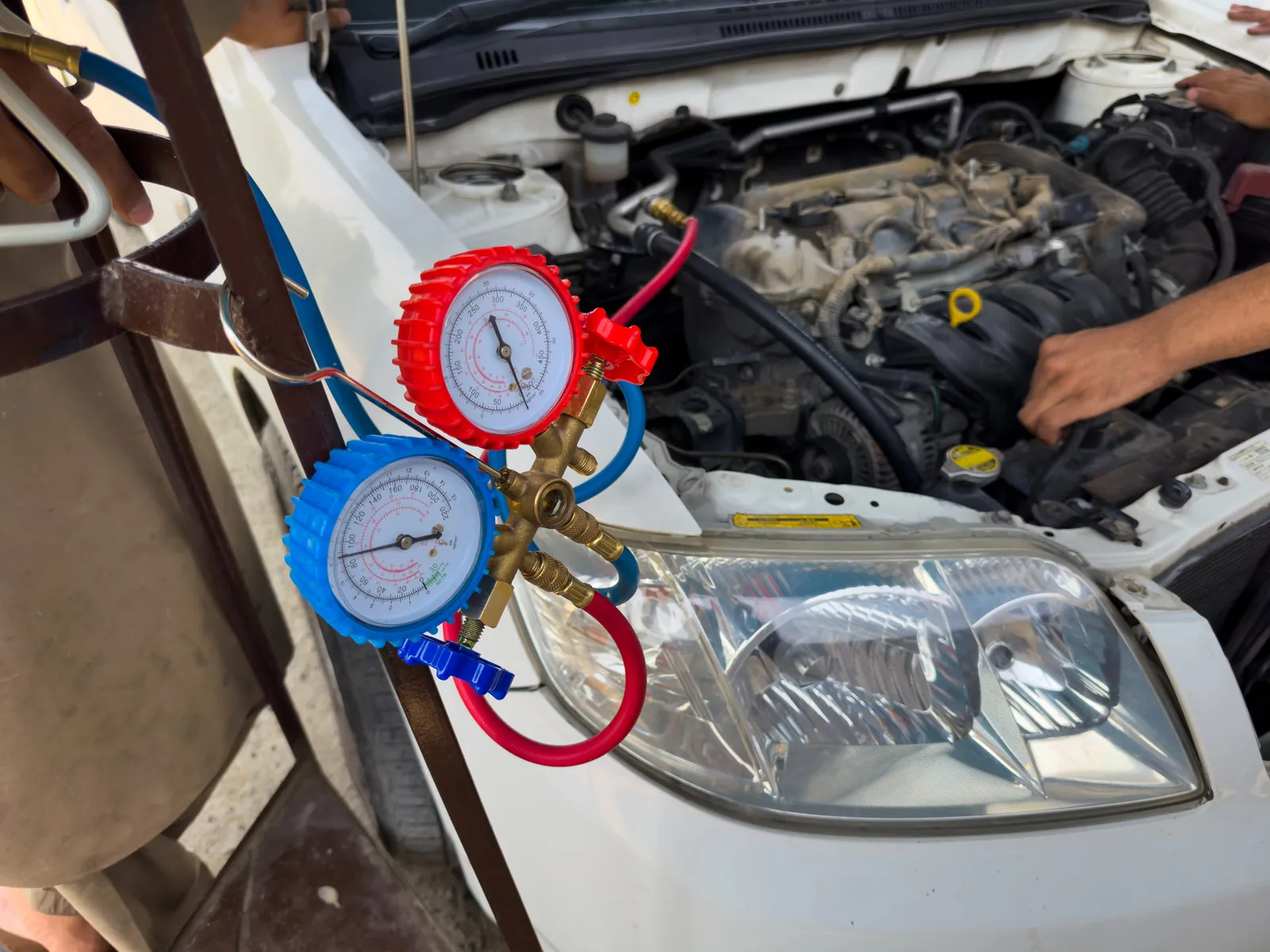
A car AC blowing hot air has either lost its ability to move heat out of the cabin, or it is making cold air that does not reach the vents. Low refrigerant is a frequent reason, and refrigerant gets low because of a leak. A compressor that does not run, a condenser that cannot shed heat, an electrical fault and a door inside the dash stuck on heat are the other usual candidates.
Vent temperature alone does not say which one applies. The pattern helps: warm the whole time, cold on the highway and warm at stops, cold on one side only, or cold at first and warm later.
If the air in your car has gone warm, Golden Star Mobile Mechanics performs mobile A/C repair where your vehicle is. We test to confirm what is keeping the air warm before parts are replaced.
How Car A/C Makes Cold Air
An air conditioner moves heat out of the cabin. The compressor squeezes refrigerant gas, which heats it. In the condenser at the front of the car, that heat passes to the outside air and the refrigerant turns to liquid. It then expands into the evaporator behind the dash, turns very cold and absorbs heat from the cabin air blown across it. A blend door mixes that cooled air with heated air to give the temperature you set.
Common Causes of Hot Air From the Vents
Low refrigerant
The system is sealed, so refrigerant is not used up. If the level is low, it has leaked out through a hose, a seal, the condenser or the evaporator. Cooling often fades gradually before it stops. Many systems switch the compressor off when the level falls too far, to protect it.
A compressor that does not engage
On many cars you can hear a click from the engine bay when the A/C is switched on, as the compressor clutch engages. No click can mean a clutch, fuse, relay, switch or wiring fault, or the system protecting itself because refrigerant is low. Some compressors have no clutch to click, so a quiet engine bay is not proof.
A condenser or fan problem
Air that is cold while the car moves and warm at a stop suggests the condenser is not getting enough airflow. A cooling fan that does not run is one possibility. Fins packed with dust or debris are another, and a low refrigerant level can behave the same way. In desert heat, a system with little margin shows this pattern first.
A blend door or control fault
If the refrigerant side is working and the vents are still warm, a blend door or the small motor that moves it may be stuck on heat. Cold air on one side and warm on the other can point here, though on some vehicles low refrigerant causes the same split.
An engine that is running hot
Some vehicles switch the A/C off when engine temperature climbs. If the temperature gauge is high and the vents turn warm, the cooling system is the first concern. Stop where it is safe and turn the engine off, and leave the A/C for later.
